Thursday, 5 August 2010


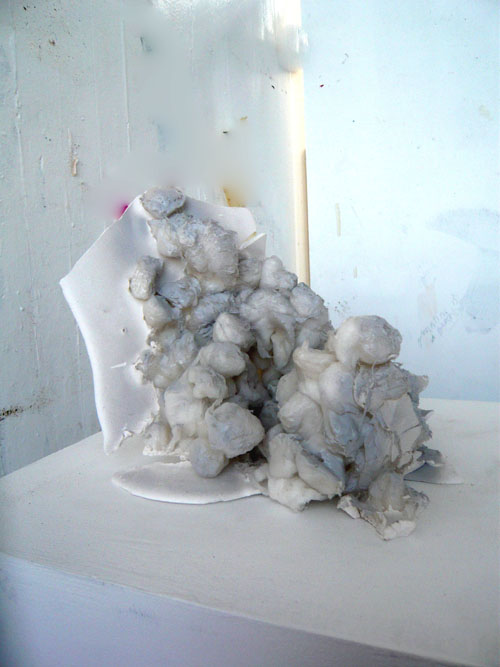
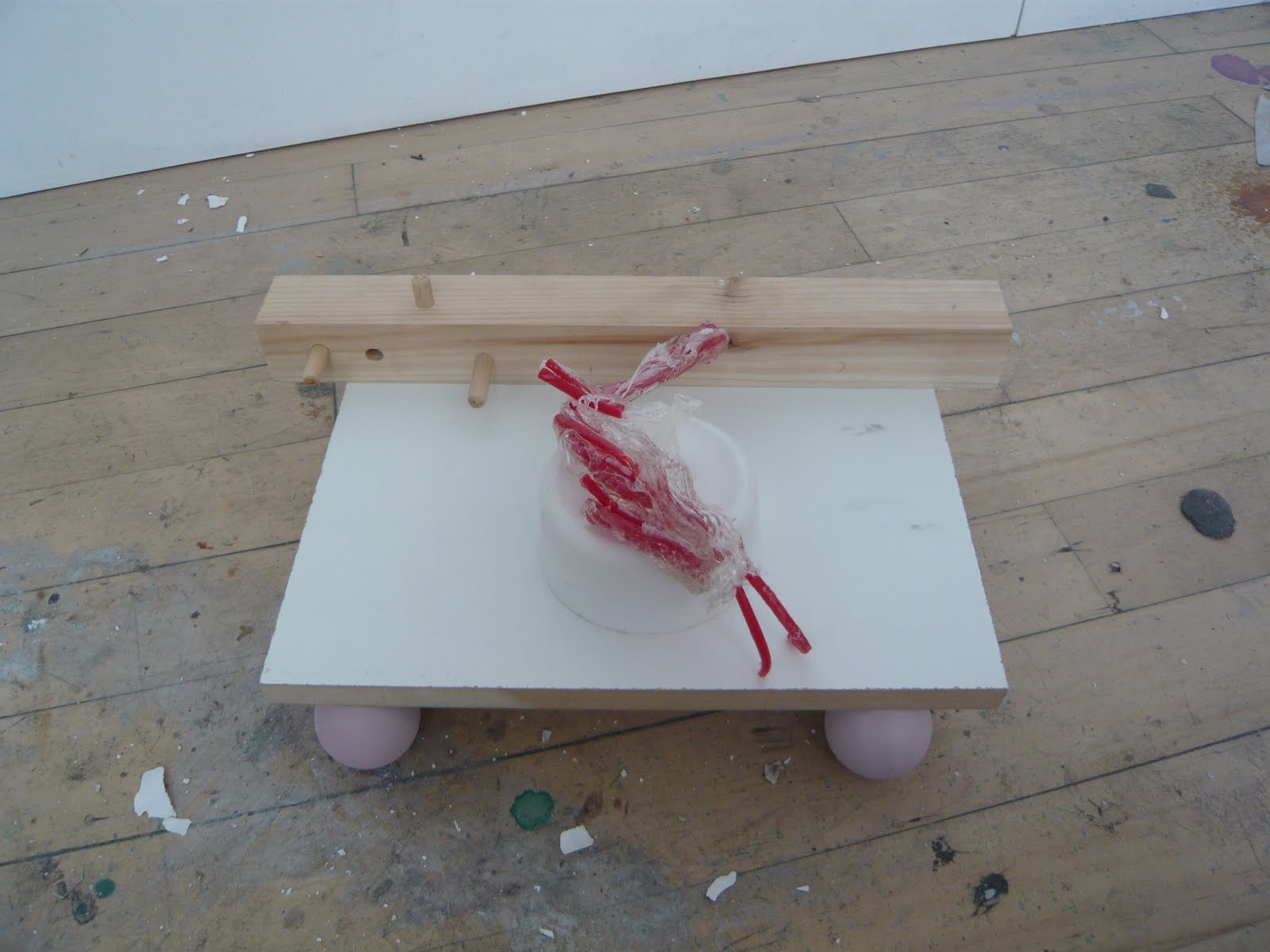
An object testing out balancing objects on objects. Board balanced on pink lightbulbs with plaster object, licorice and glass wax and wood.


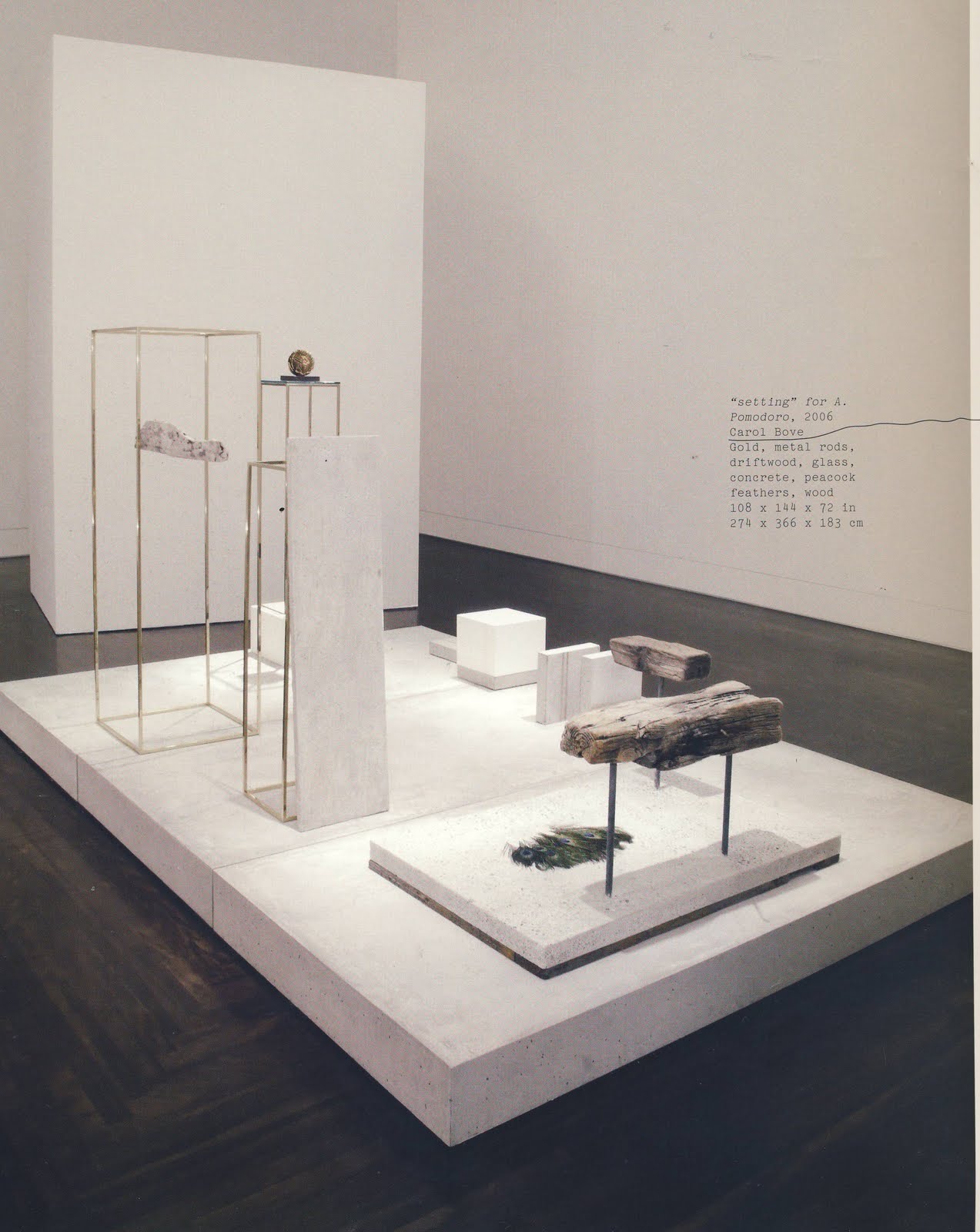
'Setting', Carol Bove, 2006, Gold, metal, rods, driftwood, glass, concrete, peacock feathers, wood.

Having spent a few weeks collecting objects and making, it's time to move into E25 space to see how the pieces might work in our exhibition space.

At this point, reflecting on how I might install the works I am considering one sculpture in the centre of the room which is made up of ecletic elements but unified on a base structure. An example of a work which has similarities to my ideas is Carol Boves piece, see image. Bove is from Switzerland and her sculptural configurations bring together approriated objects and temporary materials. Her primary concern is very different to my own work as the tableaus allude to a reading of postwar history. However, the narratives which are reflected in the work associate with time and place which can be also be seen in my work. Bove's approach to the 'whitecube' gallery space is similar to sculptors such as Carl Andre and John McCracken but conceptually her work is derived from 1980's approriation. She creates a tension between the approriated objects and interior design layout outs and materials.

I decided againist using this method of unifiying my objects. And then I wondered why I felt the need to unify them at all? Why not let them stand on their own? But there still is something missing, I feel that developing dialogues between selected objects could be the way forward. I also want to maintain the physical connection between the work and the viewer so I would like to make the work as accessible as possible.

Objects in my space.


I tend to lay things out orderly before I find a use for them. Sometimes even in just randomly laying things out, I make connections between different elements.


July 7th 2010.

During my tutorial with Kristin. I began thinking about the care I give to the base's of my sculptures. I don't want them to look just like salvaged pieces but I want to find a way to make them an integral part of the piece. Kristin described my works as crude and commented on whether I used the bases in order to counteract this by making them visually beautiful. The way I work with these parts should be unintrusive in a way that it hightlights the focal part of the work. We also discussed recording my working process with video. This may highlight aspects of my process which I am unaware of, if nothing else however, it serves as a document of making. We also discussed looking at Picasso and Bracusi. The use of this blog will help me in being selective in the final stages as viewing the pieces in isolation from the rest of my studio clutter will help me to determine which ones work and which one's aren't.We also mentioned casting and how though I have begun to make from scratch and use found objects, the casting is still an important part of my practice.

Inspiration for Logo/marketing


We were inspired by the now widely recognised poster 'Keep calm and move on' which was made during the Second World War to keep the people's moral up. It is now widely printed. I think it is an effective image due to it's simplicity and alternating colours. We used this as the basis for creating our Just to Say poster series.

It was difficult to create a statement which we were all satisfied addressed our work within the group show. So we put together a recording of our walk between the two venues of Just to Say. I typed this out as a transcript. It will be linked to a map on our catalogue. We felt this was an interesting approach as it develops the link between the venues very accutely which increases the likelihood of visitors viewing both shows.

Full derive transcript:

Derive statement:
Exiting the building, get your umbrellas out girls. Down to Cowgate. Derive means..Urban wander...to drift. Birds eat seeds and then they poo them out and then plants grow. I think someone should re-design umbrellas. Sometimes I shrink mine down to get through places. Definitely. A downward slope from the college to the Cowgate. Oh wow is this new? Oh I’m sorry I got stuck. Need to get my haircut. This area is so up and coming. Why don’t we get a tattoo? If I knew what I wanted then I would get one. Try and keep it under. Hasn’t rained like this in ages. Like 100. Just a template of a dress. The little teapot necklace. Exactly, it’s near the art college. It’s a shopping journey. The flag..those are kinda new. I’m inappropriately dressed for rain. Maybe we should keep walking...we’re definitely in the way. That must have been quite painful. Swimming? Twenty four hours. The money in the pocket. The record of the derive. Take number two, at the apex hotel onto the cowgate. Deep-end. It’s a cafe. Lovely. It was for shepherds to rest in when they were out in the hills. The herds being sheperdherded back in, two little dogs chasing the sheep. With the Christmas lights. Tea towel on your head- yeah that was my Grandad. Most still have the crooks. If a sheep lands on it’s back it will never be able to get up again. If it’s still got its wool. Do you think another sheep could help? Uncle and Auntie used to turn them over. Wasn’t working, just walked around and turned sheep over. Onto the Cowgate. Candlemaker row. I guess these are plumbing pipes? These are just for the gutters. Plumbing pipes are internal. Main pipe for the toilet outside which stop at each level. The bit that’s running at the top? The overflow. Go up to the right..left. Quite a drop though. Is it a working church? It’s a dentist. Yeah I love this part. What’s the art word for that? You can see the layers, what’s already been. Palamsest. Onward. The underbelly. There’s a yard area or something. Oh is that the one which burnt down? Nice. So dangerous. No not been there! Er no. You have to be quite drunk. Who are the three sisters? Dead bird. A bird eating a bird, birdism. I have this impression I always see this area in rain. Always the poor section. All the shit flows down. You will have. Can’t picture this street in the sun. Is it burlesque? Lose all spatial awareness. Peek in the hole...there’s a doorway. A lot of work to do. Like in Harry Potter. If only the spell worked. Nearly half and hour. Feels like a totally different neighbourhood. Craving a cup of tea.

Casts of pine cone thing found at Blair Atholl Castle.


CVCS handed in 2nd of August!

List of books/articles studied during the last semester so far:

Agamben Giorgio (ed), Cy Twombly : Sculptures 1992-2005, Schirmer/Mosel, Alte Pinakothek: Munich, 2006.

Allmer Patricia, (ed), Angels of Anarchy: Women artists and Surrealism, Prestel, Manchester Art Gallery: Manchester, 2010.

Blazwick Iwona, (ed), Katharina Fritsch , Tate Publishing: London, 2002.
Chambers Gloria (ed), Helen Chadwick Stilled Lives, Portfolio Gallery: Edinburgh, 1997.

Dumas Marlene , MD, Museum van Hedendaagse Kunst Antwerpen: Mukha, 2000.
Hamilton Bruce, Hamilton Ann, Sao Paulo/Seattle, Henry Art Gallery, University of Washington: Seattle, 1992.

Hiller Susan and Martin Sarah (eds), New Sites- New Art, First Baltic International Seminar: Newcastle, 2000.

Horowitz Deborah (ed), The Uncertainty of Objects and Ideas: Recent Sculpture, Hirshorn Museum and Sculpture Garden: Washington DC, 2007.

Huttner Per (ed), Curatorial Mutiny, Critical and Creative texts on the role of the contemporary artists and curator, Offerset : Sweden, 2003.

Jopling Jay, Doris Salcedo: Neither 10 September-17th October ,Whitecube: London, 2004.

MacDiarmid Hugh, Gareth Fisher, sculpture, Fruitmarket Gallery: Edinburgh, 1986.
Puck Karin, Richter Dorothee, Weigle Petra (eds) Curating Degree Zero; an international curating symposium, Institute fur modern Kunst Nuremberg: Bremen, 1999.

Rosicio del Nicola, (ed), Cy Twombly Catalogue Raisonne of Sculpture, v.1, 1946-97, Schirmer/Mosel, : Munchen, 1992.

Rugg Judith and Sedgwick Michele (eds), Issues in curating contemporary art and performance, essay: Wells Liz, Curatorial Strategy as Critical Intervention: The Genesis of Facing east, Intellect Books: Bristol, 2007.

Serota Nicholas, Experience or Interpretation: The Dilemma of Museums of Modern Art, Thames and Hudson: London , 1996.

Vergine Lea, When Trash Becomes Art; trash rubbish mongo,Thames & Hudson: London, 2007.

“10 Curators- A Conversation, on the Internet”, Ice Cream: Contemporary Art in Culture, Phadion: London, 2007.

Websites:
Cumming Laura, The Observer, Sunday 9th August 2009, Female curators throw new light on women's work, [Online] Available: http://www.guardian.co.uk/culture/2009/aug/09/eva-hesse-sculpture-edinburgh[Accessed 28/07/10]

Fundaciotapies, Barcelona, (2010) 14 May- 1 August, Eva Hesse Studioworks. [Online] Available: http://www.fundaciotapies.org/site/spip.php?rubrique952 [Accessed 28/07/10]

Jordan Elizabeth, Installation shots: Tentative Trial and Effective Error, Room two, [Online] Available: http://www.lizzyjordan.co.uk/Tentative%20Trial%20installationr2.html [Accessed 16/07/10]

Micchelli Thomas, Unmonumental: The Object in the 21st Century
Collage: The Unmonumental Picture, [Online] Available: http://www.brooklynrail.org/2008/02/artseen/unmonumental-the-object-in-the-21st-century-collage-the-unmonumental-picture [Accessed 28/07/10]

Scobie Ilka, Artnet: The Uncuratorial Curator, 2007. [Online] Available: http://www.artnet.com/magazineus/features/scobie/scobie11-27-07.asp. {Accessed 27/07/10]

White Michelle, Art Lies: Contemporary art Quarterly (2010) Unmonumental: the object in the 21st century, [Online] Available: http://www.artlies.org/article.php?id=1641&issue=58&s=0 [Accessed 27/07/10]
Wow what a productive few weeks! The work I'm making for the show is a series of sculptures, which stand on their own as individual pieces but are also interlinked. I began the project by gathering all leftover materials in my new space and intuitively making objects. I have always had an experimental and free way of working within my studio. My space is always filled with eclectic bits and pieces. I know it's good to clear things out; unfortunately I am also a hoarder! I also find myself building on objects again maybe a while after initially making them. An important part of my work is my shopping! I am continuously looking for new materials. Recently, I have found car boot sales to be the most fruitful. But also, having a tendency towards the ephemeral, even trips to the supermarket usually end up sculpture related. I have already uploaded a few of my first objects. During a tutorial, Gordon and I discussed the way in which I place these pieces on boards. For me, this is a way of separating them from just the studio floor and trying to view them in a cleaner environment so I can assess the next move. But we discussed the boards as something I could take forward on to the exhibition.
The objects made in my studio, I had long considered not worthy of entering an exhibition space. I would enjoy the process thoroughly and then ponder ways in which I could develop the initial experiment into something to show. I now believe that these combinations of materials and processes are my practice. Taking this onboard, for the forthcoming degree show, I wanted to find the best way of presenting them. I didn’t want to just place them on just plinths; I felt they needed more of an ‘edge’. So I collected ‘bases’ around college and the city. These could be; plinths, boxes, furniture and my own constructed items.
Moving from the studio into the exhibition space was key. On a practical level I was running out of room to work but also it got me in the mindset of the exhibition and how my works might and interact in the space.

Tuesday, 20 July 2010

"To feel all things in all ways"


Cy Twombly


In giving my sculptures their own individual space (as opposed to clustering them in the centre as previously proposed), this effectively breaks up the large open space in ECA and creates more intimate spaces within the objects themselves, a similar approach to Cy Twombly’s display of his ‘crude and improvised’ sculptures. Having individual pieces in the Cowgate begins to infuse the two interiors together through developing storylines between the artworks.

Saturday, 17 July 2010


Object made with cast of a plastic container in plaster, which was situated on top of a breeze block with wet clay. Then it was carved and spray painted, then eyelashes were added. It reminds me of a 'bad night out', the sense of their being a pavement and splashes of make up and colour and something crumbling away like how appearances dimish as the night goes on.


This is one of my favourite objects so far. It is made from a wooden base coated in plaster and then chalks pushed into the still wet plaster. I then carved the chalks againist the plaster. It reminds me of a sad birthday cake, deteriating. The chalks are nostalgic of childhood and innocence.


As a group of artists, we selected two venues for Just to Say. Edinburgh College of Art is large, open and white cube and the space within the Cowgate area of Edinburgh; an abandoned shop/office, is smaller, intimate but more architecturally complex. In using a venue in the city we are aware that many artists/curators have chosen to work with projects and exhibitions in alternative sites in public. Exhibitions in public spaces are easily accessible to anyone and therefore have the potential to reach far beyond the relatively selective art audience. The Cowgate space has potential for us in an opportunistic sense as it stands in a busy and popular area of the city.


The Cowgate space has three rooms. My works will be placed on the Cowgate shop floor but will be contained to the one room, which is the less architecturally obtrusive. As my work is quite organic and raw I do not believe it would work well against some of the awkward geometries of the other spaces. I would prefer to present them in a more traditional space as don’t want the space to dominate but rather for the work to engage and maintain the viewer’s attention.

See above a proposal for the layout of our work at this venue.


History of the Cowgate:
The cowgate- name derived from the cows led down the street on market day. As it is beneath the elevated streets above, has a tendency to be dark and gloomy. From the mid 18th century to the wars the cowgate was a area typically where the poorer community lived, an overcrowded slum area.

This year, my practice has maintained a strong attachment to materials and experimentation. For the MA show, instead of developing these experiments into a different work, I have decided that it is the original experiment itself that is the most significant element of my practice.

Upon discussion, for the four artists involved in the MA programme, a loose strand of common issues and emotions in our work is an understanding and knowledge of the world around us is gained through the process of making and looking. Though delving into these explorations may not provide answers, it is the stimulus for questions and discussion. This abstract way of approaching our practices together as one show led to the title Just to Say, expressing our need to put an idea/ feeling out for interpretation.

In exploring using my experiments for a final work, a particular point of reference is the Eva Hesse Studiowork exhibition. This was an exhibition of her studio experiements, which Hesse described as ‘samples’. I enjoyed parts of how this collection of eccletic objects were displayed and felt that where they worked most successfully was as displayed below as the viewer could really get a ‘feel’ for the works, in the sense of their materiality and complexity.

Areas of the exhibition that were less successful were where they were contained in museum style glass cases, this gave them the air of being relics and also distanced the viewer from the works, making the feel of the materials less alive and tactile. I believe Hesse’s work is presented best as it was made and not curatorially controlled. This is something that is important in my own work, giving my experiements a life out of the confines of the studio I want to encourage interactivity from the viewer in order for them to gain a sense of the constructing of the work and of the enjoyment of making it.

Layout of ECA E25..

To begin with, the physical nature of our individual works dictated their display more than conceptual linkage. Catriona Reid’s work is site-specific within her chosen areas of the college, Lindsey Fyfe’s work is two-dimensional displayed on well-lit walls and Diane Melot is a film maker so she makes use of the projection room. My work, being sculptural, operated well in the main body of the room; in order to be viewed from all angles and perspectives.


We will curate the show in order so the works are not merging but to rather to reflect juxtapositions as well as gain an overall sense of unity as a show. For example, placing my crude objects next to Lindsey Fyfe’s refined and formal will heighten a sense of juxtaposition through textures and surface; however, this also builds an affinity between the works as Lindsey Fyfe’s grid formation paintings fit well next to the geometric structured bases of my sculptural work. Upon detailed observation, what initially appears to be disorder in my work actually is balanced out through strict structured display and in Fyfe’s paintings; the repeated formal lines on close inspection actually reveal hints of wiggles and the hand of the artist: a subtle touch of chaos. Additionally, both Catriona Reid’s banister wall drawing and Diane Melot’s string sink work have a similar play with lines and levels as well as being playful and suggestive of a continuing experience, both achieved through differing technique and materials.


The manipulation of everyday objects by artists can be traced back to art gestures by Marcel Duchamp ‘s Ready-mades and the activities of the Dadaists. The surrealists focused on the poetic possibilities of objects. Another field I have been exploring is Arte Povera- with its concerns with process, unmediated and no precious materials is a source of inspiration for my own work.

http://www.arcadja.com/artmagazine/it/wp-content/gallery/080418-kounellis/senza-titolo-di-j-kounellis.jpg

http://images.artnet.com/artwork_images/424196454/451114.jpg

https://www.brooklynmuseum.org/community/blogosphere/feministbloggers/wp-content/uploads/SarahG/Kounellis.jpg

Feedback session 2nd June

The beginning- Feedback session 2nd June 2010
During the feedback session we discussed the moving of studio spaces to complete the remaining duration of the MA. I felt I would benefit from moving space as I had found the previous space difficult to work in and wanted to begin a new body of work and so I felt a change in environment could be beneficial for this. My progress was commented on particularly with regards to the residency in Chicago as this helped to free up some of my working methods and thoughts. For me, Chicago was an important stage for me as it was a situation in which I was forced to put everything I had been working on in Edinburgh aside and focus on the moment, the things I was experiencing on a daily basis in Chicago as well as responding and using materials to hand. This way of working has continued and progressed into the last semester. Helen Chadwick was mentioned as an artist whose work would be interesting to look at with reference to some of her less ‘planned’ works. Overall, the feedback meeting combined with the realisation of a new space to work left me feeling positive and has led into a playfully productive next few weeks.

http://www.nationalgalleries.org/whatson/exhibition/5:368/18379

Research.


The Unmonumental Exhibition.


In researching the exhibition Unmonumental: the object in the 21st century, it seems that the curators (Richard Flood, Laura Hoptman and Massimiliano Gioni) seized the opportunity of working with and responding to a new space, similarly to our approach with the Cowgate space. The show was held at the New Museum of Contemporary art in New York. In an interview, Gioni states: ‘All of the sculptures are installed in the galleries without any partitions or temporary walls. The installation reveals the original architecture in all its purity, with the artworks occupying space but not as a rule touching the architecture... ’ (Scobie, 2007). This I feel is very successful when exhibiting contemporary sculpture, for the reason that Gioni continues: ‘Visiting the show should feel like walking around a landscape, maybe a landscape of ruins and instability ‘. For the viewer of my work, I hope to gain a sense of immersion, almost like they are walking amongst and observing particular scenes that could be seen as stills/props from a theatre/movie set or even from everyday life. What is even more interesting about this exhibition is it evolved as after a month, around the sculptures they installed an exhibition of two-dimensional works, and this was in order to make the show ‘more intense’. The curators then added sound to galleries. Gioni states: ‘Sculptures, collages and sound- it should be an incredibly dense environment, a collage in itself, or maybe a contemporary ‘merzbau’.

http://www.shuimohua.com/news/e-news/catalogue-1/2007_6/40.htm
This method of curating a ‘collage’ is interesting as in some respects we are emulating a similar experience in Just to Say. The difference being we are incorporating the different elements from the start. In both spaces my sculptures remain standing in white wall space with two-dimensional work from Fyfe and Reid in the walls surrounding and sound from Melot’s films in the adjacent rooms. It will be interesting to see the impact this has on the experience of my piece, my hope is that it will enrich the viewing experience.

Thursday, 15 July 2010

Starting out


uncertain_pilgrimage
Gareth Moore,
Have been making things for


Gareth Moore is an artist I have been researching. In his collection of sculptures he uses oridinary found objects such as: plastic bottles, brown paper bags, driftwood and rocks. His commitment to the disregarded allows for a seductive juxtaposition. The artist often talks about the reusability materials within his practice; he often recycles past works into new ones. This gives his sculptures a kind of limitless life cycle . I work in a similar way, the works evolve continuously and often I will reuse a complete object within a different structure of dismantle it entirely to use specific parts.

Monday, 12 July 2010

Making things.Please scroll down for all the objects made in my studio in the starting couple of weeks.

This first post is simply a catalogue of the pieces I have made in the last couple of weeks. It is a way for me to isolate the works and view them individually, as my studio space becomes harder to analyse things the fuller it becomes.